
SPAIRE Hip Replacement
The muscle and tendon-sparing posterior approach to total hip replacement. Performed privately by Professor Paul Lee at the 5-star Weymouth Street Hospital in London, with consultations and recovery local to Lincolnshire.

SPAIRE hip replacement, in one paragraph
SPAIRE stands for Save Piriformis And Internus, Repair Externus. It is a modern posterior approach to total hip replacement that keeps the small rotator tendons at the back of the hip intact, rather than detaching and reattaching them. The aim is a more stable hip joint after surgery and faster, more confident early mobilisation. Professor Paul Lee performs SPAIRE hip replacement privately at the 5-star Weymouth Street Hospital in London, with consultations in Grantham, Sleaford or by video.
A muscle and tendon-sparing posterior approach
SPAIRE is a modern posterior approach to total hip replacement. The technique preserves the small rotator tendons around the back of the hip joint rather than detaching and reattaching them, as some traditional posterior approaches do.
By keeping those tendons intact, the approach is intended to support the natural stability of the hip joint and help suitable patients mobilise more confidently after surgery.
Professor Paul Lee trained in the SPAIRE approach under Professor Timperley at the Exeter Hip Unit, one of the world-renowned centres for hip surgery.
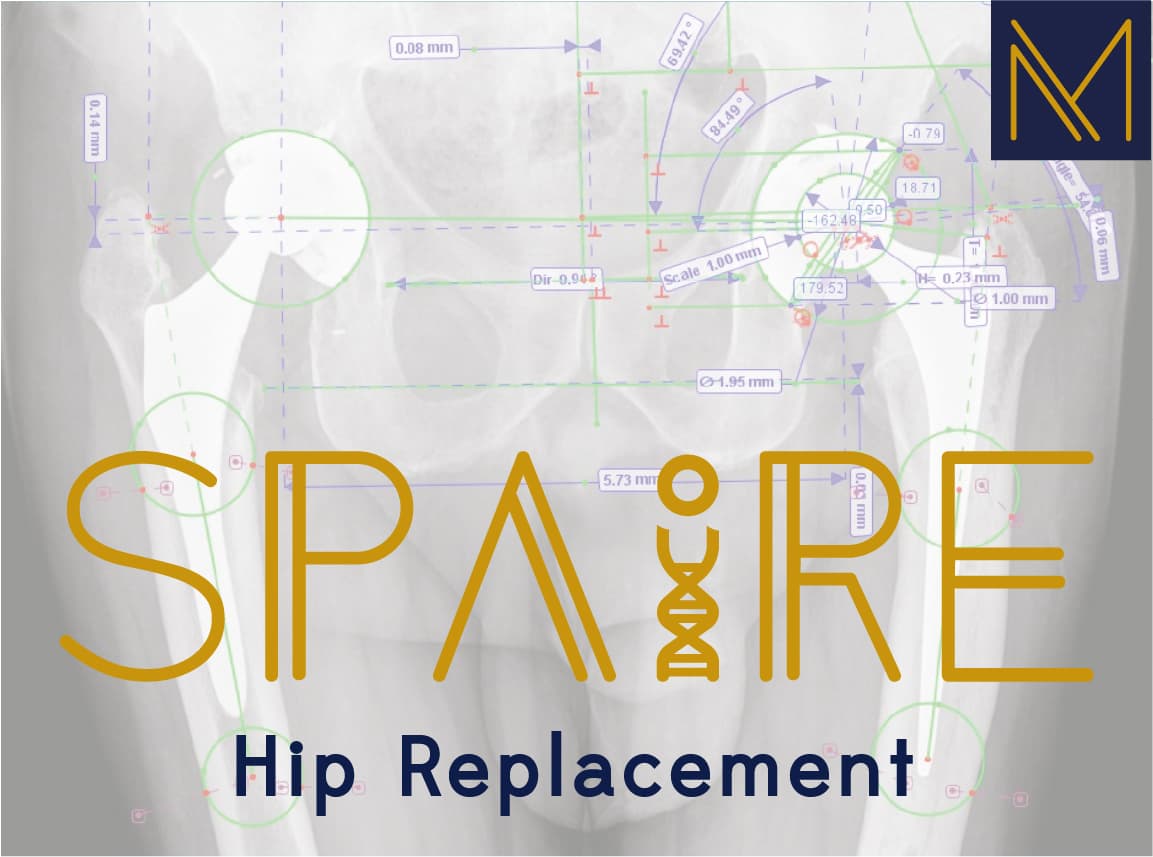
What the approach is designed to do
Preserves the small rotator tendons
The posterior small rotators are not detached, which is intended to support joint stability after surgery.
Aims to support faster mobilisation
By limiting muscle and tendon disturbance, the approach aims to make confident early mobilisation easier where clinically appropriate.
Trained at the Exeter Hip Unit
Professor Lee trained in the SPAIRE approach under Professor Timperley at the Exeter Hip Unit, one of the world-renowned hip centres.
How SPAIRE compares to other hip replacement approaches
Most total hip replacements in the UK still use approaches that detach muscle or tendon to reach the joint. SPAIRE was developed to avoid that, and it is the technique Professor Lee uses for hip replacement wherever a patient is clinically suited.
SPAIRE
The technique Professor Lee usesWhat it does: Posterior approach that preserves the piriformis and obturator internus tendons, with externus repaired at the end of the operation.
Why it matters: Designed to keep the natural posterior stability of the hip intact, with the aim of supporting earlier confident mobilisation.
Traditional posterior
What it does: Posterior approach where the small rotator tendons are detached to access the joint, then reattached at the end of the operation.
How SPAIRE differs: SPAIRE keeps those tendons attached, which is intended to support stability and recovery without relying on the reattachment healing.
Anterior
What it does: Front-of-hip approach that works between muscle planes, often using a specialised table or imaging.
How SPAIRE differs: SPAIRE is muscle and tendon-sparing through a posterior route, suited to a wider range of anatomies and body types.
Lateral
What it does: Side approach that detaches part of the abductor mechanism (gluteus medius) to access the joint.
How SPAIRE differs: SPAIRE preserves the abductor mechanism entirely, which matters for hip stability and gait after surgery.
Every approach has trade-offs and not every patient is anatomically or clinically suited to SPAIRE. Suitability is confirmed at consultation, and Professor Lee will give an honest opinion if a different approach is more appropriate for you.
Developed at the Exeter Hip Unit, trained at the source
The SPAIRE technique was developed and described by Hanly, Sokolowski and Timperley at the Exeter Hip Unit, one of the world-renowned centres for hip surgery. The technique was published in Hip International in 2017.
Professor Paul Lee trained in the SPAIRE approach at the Exeter Hip Unit under Professor Timperley, and uses it as his standard approach for total hip replacement wherever a patient is clinically suited. That direct training matters: SPAIRE is a precise technique, and how it is performed influences the outcome.
Hanly RJ, Sokolowski S, Timperley AJ. The SPAIRE technique allows sparing of the piriformis and obturator internus in a modified posterior approach to the hip. Hip International, 2017.
“I first thought that my hip pain is never gonna leave me, but then I found Professor Lee. And after I got my SPAIRE hip replacement done by him, I feel no more pain.”
A SPAIRE patient
Read more patient reviewsIs SPAIRE right for you?
Whether the SPAIRE approach is right for you is a clinical decision made by Professor Lee at consultation, based on imaging and assessment. As a general guide, suitable candidates include:
- Symptomatic hip arthritis where conservative measures have not provided sufficient relief
- Patients clinically suited to a posterior surgical approach
- Patients confirmed as fit for surgery on pre-operative assessment
Honest about the limitations
- Not every patient is anatomically or clinically suited to the SPAIRE approach. Your suitability is confirmed at consultation.
- As with any hip replacement, there are individual risks. These are discussed in full before any decision to proceed.
- SPAIRE is one of several modern hip replacement approaches. The choice of approach is a clinical judgement made with you.
SPAIRE hip replacement: common questions
What does SPAIRE stand for?
SPAIRE stands for Save Piriformis And Internus, Repair Externus. It describes a modern posterior approach to total hip replacement that keeps the piriformis and obturator internus tendons intact and repairs the obturator externus at the end of the operation.
What is the SPAIRE hip replacement technique?
SPAIRE is a muscle and tendon-sparing posterior technique for total hip replacement. Where traditional posterior approaches detach the small rotator tendons at the back of the hip to reach the joint, SPAIRE leaves those tendons attached. The aim is a more stable hip joint after surgery and faster, more confident early mobilisation.
How is SPAIRE different from a traditional posterior hip replacement?
In a traditional posterior approach the piriformis and obturator internus tendons are detached and then reattached. In SPAIRE these tendons stay intact and only the obturator externus is repaired. That preserves more of the natural posterior stability of the hip, which is intended to reduce reliance on tendon reattachment healing.
How is SPAIRE different from anterior hip replacement?
Both SPAIRE and anterior hip replacement aim to preserve muscle and tendon function, but they reach the hip from different sides. SPAIRE is a posterior, muscle-sparing approach suited to a wide range of anatomies and body types and does not require a specialised traction table. The right approach for any patient is a clinical decision made at consultation with Professor Lee.
Is SPAIRE better than other hip replacement approaches?
For patients who are clinically suited to it, SPAIRE offers two clear advantages over approaches that detach the small rotators or the abductor mechanism: it preserves the natural posterior stability of the hip, and it is designed to support faster, more confident early mobilisation. Suitability is confirmed at consultation, and Professor Lee will give an honest opinion if a different approach is more appropriate for you.
Who developed the SPAIRE technique?
SPAIRE was developed and described by Hanly, Sokolowski and Timperley at the Exeter Hip Unit. The technique is published in Hip International (Hanly RJ, Sokolowski S, Timperley AJ. The SPAIRE technique allows sparing of the piriformis and obturator internus in a modified posterior approach to the hip. Hip Int, 2017). Professor Paul Lee trained in the SPAIRE approach at the Exeter Hip Unit under Professor Timperley.
How long does recovery take after a SPAIRE hip replacement?
Recovery looks different for every patient. By preserving the small rotator tendons, SPAIRE is intended to support earlier confident mobilisation than approaches that detach them. Your recovery timeline and any restrictions are confirmed by your surgical team based on your procedure. The £17,800 private hip replacement package includes unlimited post-op physiotherapy at our Grantham or Sleaford clinics, as often as your recovery needs.
Where can I have a private SPAIRE hip replacement in the UK?
Professor Paul Lee performs SPAIRE hip replacement privately at the 5-star Weymouth Street Hospital in central London. Consultations and recovery happen locally in Lincolnshire (The Keep Clinic in Grantham or MSK House in Sleaford), and a private luxury car service to and from London is included for eligible UK patients as part of the £17,800 package.
Recovery support is part of the package
SPAIRE is one part of the £17,800 hip replacement package. The package also includes an overnight stay at the 5-star Weymouth Street Hospital, a private luxury car service to and from London for eligible UK patients, local follow-up in Lincolnshire, and unlimited post-op physiotherapy at our Grantham or Sleaford clinics.
Recovery looks different for every patient. Your recovery timeline and any restrictions will be confirmed by your surgical team based on your procedure.
Talk it through with our team
Free discovery call
Discuss whether SPAIRE is right for you
A free non-medical call to walk through the pathway. Confirmation of suitability happens later at a clinical consultation.
Patient journey
See the 8-step pathway
From free discovery call to local consultation, London surgery and unlimited Lincolnshire physio.
Your surgeon
Meet Professor Paul Lee
Consultant orthopaedic surgeon trained in the SPAIRE approach at the Exeter Hip Unit.
Cost & what’s included
See the £17,800 package
A complete breakdown of what the SPAIRE hip replacement package includes, with no surprise charges.
Explore more
The £17,800 private hip replacement package, the SPAIRE technique, recovery support and everything else you need to make the right decision.